
How to standardize FAT and SAT procedures across multiple sites
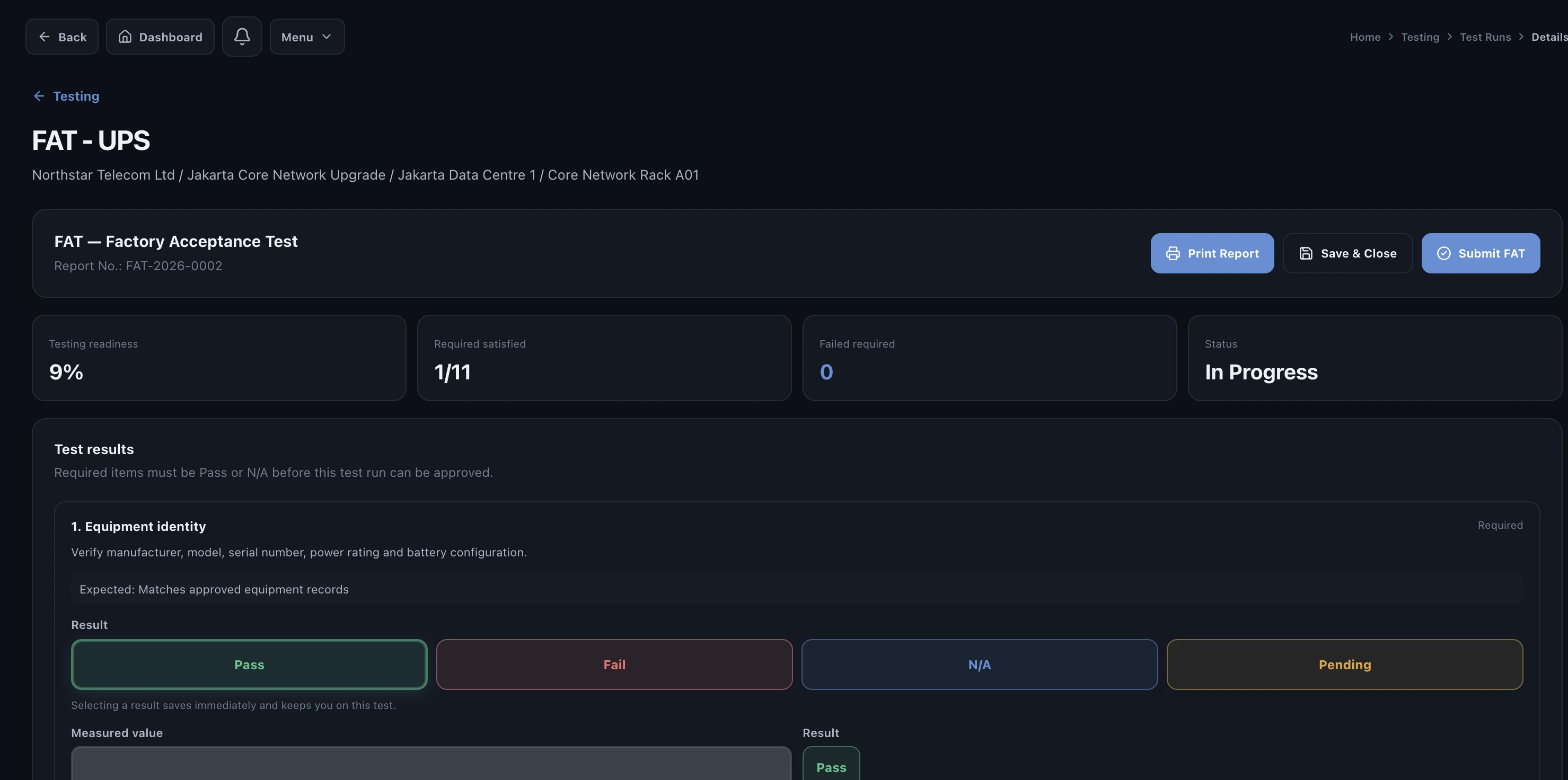
Multi-site projects need consistency and flexibility at the same time. The customer expects the same acceptance criteria at every location, while field conditions, installed equipment and individual issues will inevitably differ. The best approach is to standardize the procedure and keep execution records site-specific.
Why copying spreadsheets is not standardization
A common approach is to create a master workbook and copy it for each site. The first copy may be identical, but the files begin to diverge as users change wording, add rows, fix formulas and adapt the procedure locally. Within a few deployments, the organization no longer knows whether every site was tested against the same criteria.
Separate the test definition from the test execution
The test template should define what needs to be tested: sections, steps, expected outcomes and acceptance criteria. A test run should record what happened when that procedure was executed against a particular system at a particular site.
| Template | Test run |
|---|---|
| Controlled test steps | Actual pass/fail result |
| Expected outcome | Observed result |
| Standard evidence requirement | Site-specific evidence |
| Default acceptance criteria | Issues and exceptions |
| Procedure version | Operator, date and approval history |
Version the procedure
When a test procedure changes, existing completed runs should not silently change with it. The project needs to know which version was used at each site. A revised template can be used for future runs while historical results remain linked to the procedure under which they were executed.
Allow site-specific evidence without site-specific procedures
One site may have a network dependency, another may require a different photograph and a third may encounter a local installation issue. Those differences belong in the execution record. They should not require each site to maintain its own uncontrolled copy of the procedure.
Use exceptions to improve the standard
Repeated failures across several sites are valuable information. They may indicate a weak installation method, unclear test wording or a product problem. Because the test definition is consistent, management can compare outcomes across sites and decide whether the standard procedure needs to change.
How Valtoroq handles reusable testing
Valtoroq separates reusable FAT, SAT and commissioning templates from individual test runs. Teams can organize templates into sections, execute them against specific systems, preserve each run's evidence and issues, and maintain an approval history without duplicating the underlying procedure for every location.